Mimikara: Learning the Japanese You Actually Hear
Most language apps teach words in an order that has almost nothing to do with the language people actually speak. You finish a unit on classroom vocabulary and stationery, then watch an episode of something and understand nearly none of it. The vocabulary was real. The order was wrong.
During my PhD in artificial intelligence, I spent years watching machines learn, and it looks nothing like memorizing a list: a network learns through weights on the connections between nodes, until a structure emerges that captures how things relate. That stuck with me, and it is why I built Mimikara as a tree of logical links rather than a pile of flashcards. It is an iOS app that teaches the 5,000 most common Japanese words in frequency order, connects them through the kanji they share, and runs entirely on your phone.
Memorization leads nowhere
I spent years trying to memorize Japanese words. Textbooks, paid apps, courses, the whole shelf. It does not work. A memorized word sits in a list, retrievable if you concentrate. An acquired word simply arrives when you hear it, and nothing I was using helped me cross that gap.
Streaks, levels, badges, a satisfying sound when you finish a lesson: none of that correlates with understanding anything. Most of these products profit from you coming back, not from you actually learning the language.
Courses teach sounds, not structure
Official courses hand you よろしくお願いします in week one, tell you it's something people say, and stop there. But よろしく means roughly "favorably," and お願いします is "I ask": together, "please treat this favorably." Once you see that, it stops being an incantation and becomes a sentence built from pieces that show up everywhere else.
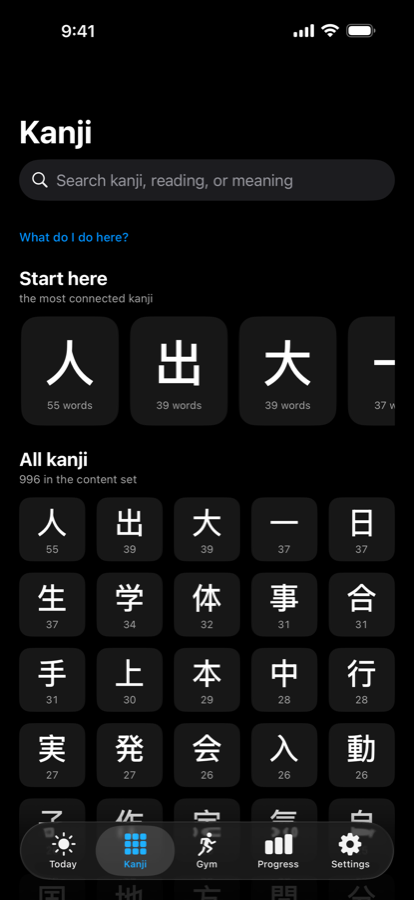
This is what Mimikara does instead of handing you phrases to parrot: every word is connected to the other words that share its characters, so the building blocks get reused instead of each word arriving as a fresh, unrelated string.
The mnemonic illusion
The other popular approach is mnemonics: a little story for every kanji. Some genuinely work, most get strained, but the real problem is learning kanji in isolation at all. Japanese people learn kanji by writing them because they already speak the language and are attaching characters to words they know. Copying the writing without the vocabulary skips the part that made it work.
An app built for one person's learning style
Mimikara is built for how I learn, and I make no claim it is universal. No cartoon mascot, no visual candy for showing up, just vocabulary in a sensible order with the structure visible.
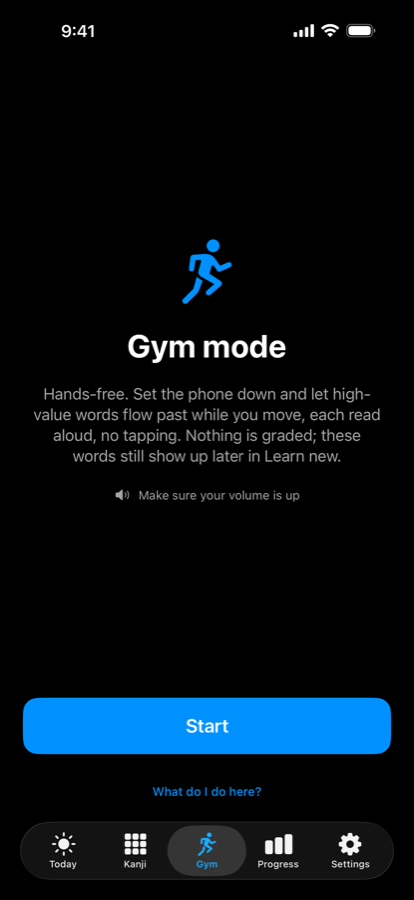
I also spend time at the gym, so there is a hands-free mode: put the phone down, and high-value words flow past and are read aloud while you move. Nothing to tap, nothing to grade.
Free, offline, and no data changing hands
Mimikara is free, with no ads, no subscription, and nothing to buy. It also has no account, no server, and no network requests: everything runs on the device, nothing collected or transmitted.
The internet is full of work other people gave away, and I have learned from it for years without paying anyone: open dictionaries, open corpora, open research. Mimikara is built on exactly that kind of work, and it credits the projects it depends on. It felt like time to give something back.
Mimikara is on the App Store now. Everything about it, including support and privacy, lives at mimikara.apps.torvenlabs.com. Go and learn something.